Nepal at the Olympics: A Journey Shaped by Wildcards
104 athletes. 60 years. 16 Games. 8 sports. And a medal tally that has never left zero-not because Nepal's athletes couldn't run, punch, or shoot, but because the officials back home never got off the bench.
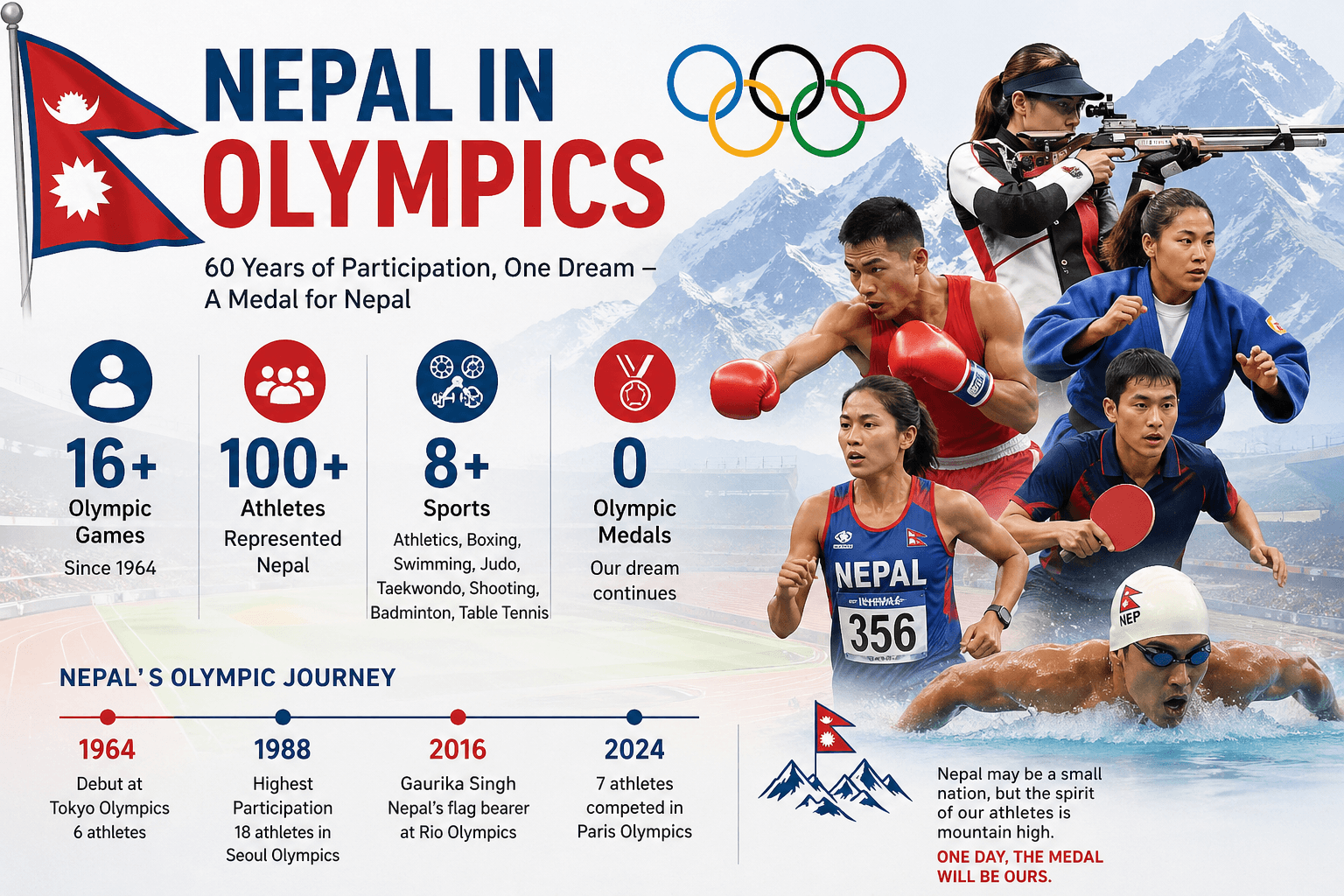
When Om Prasad Pun put on his boxing gloves and stepped into the ring at the 1964 Tokyo Olympics, first he was carrying the hopes of his nation, then making its Olympic debut. Nepal's debut was modest six men (boxing and marathon) which seemed, at the time, like the start of something historic. But six decades and 16 Olympics later, it is still very much the same: A beginning, continually postponed. Nepal has sent 104 athletes (70 men and 34 women) to the Olympic Games from Tokyo to Paris. The Games have expanded the number of sports: from boxing and marathon in 1964 to swimming, judo, taekwondo, shooting, weightlifting, archery, badminton and table tennis in 2024. The players have travelled the globe and stood on the world stage. The medal haul, after 16 games, in every sport, over 60 years, is zero.This score is not a badge of honour. It is an indictment.
"Nepal has shown up to 16 Olympics. The real knockout has come from within."
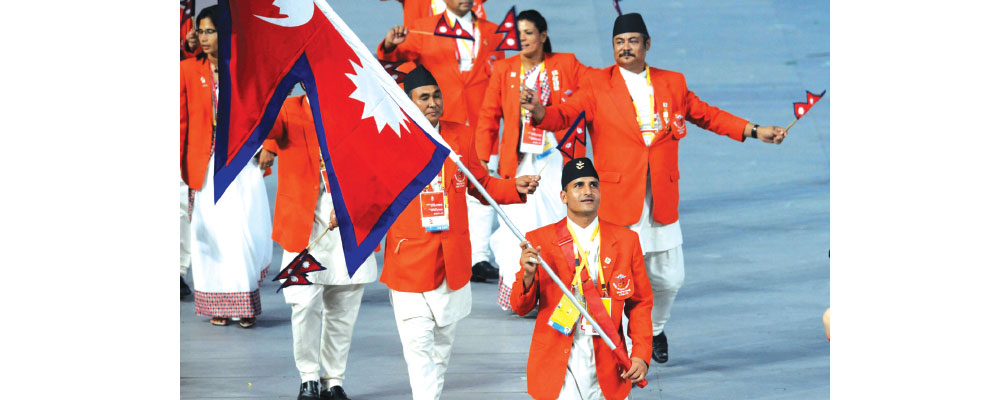
Nepal Team March Past (Beijing,2008)
Photo Credit: The Rising Nepal
A Nation Begins to Run: 1964–1988
The Nepali Olympic journey begins humbly. The team of six who competed at Tokyo 1964 - Om Prasad Pun, Ram Prasad Gurung, Bhim Bahadur Thapa and Nam Singh Thapa in the boxing, and Ganga Bahadur Thapa and Bhupendra Silwal in the marathon - were pioneers of the first order. Nepal was barely ten years out from the end of the Rana oligarchy, and the nation's infrastructure, including sport, was in its infancy
 |
Photo: Women Splashing Water on Bhupendra Silwal's foot during Tokyo Olympics |
The 1968 Mexico City Olympics were missed entirely - a harbinger of the weakness in organisation that would be a constant theme. Two athletes (Jit Bahadur KC and Bhakta Bahadur Sapkota) in athletics were sent to the ‘Bad Old Days of Munich 1972’. Montreal 1976 saw one athlete, Baikuntha Manandhar in athletics, a name which would become one of the most familiar in Nepali Olympic history, perhaps the first "Olympic regular".
The 1980 Moscow Olympic Games saw the largest team to that point: 12 men in boxing, marathon, athletics and weightlifting. The Cold War era had resulted in a reduced international field, but Nepal was there. This was followed by eleven athletes in the 1984 Los Angeles Games. Then came Seoul 1988 - Nepal's numerical high point. It sent 18 athletes (15 men and 3 women) to Seoul to compete in the greatest variety of sports Nepal had ever tried: boxing, athletics, weightlifting, judo, shooting and taekwondo. This was the first time Nepalese women were in the Olympics. Rajkumari Pandey ran in athletics; Parbati Thapa took aim in shooting; Menuka Rawat ran in athletics. Their presence was, to say the least, historic.Their performance however, in competitive sense, was what was expected , last place finishes ad early exits.However, Nepal's performance has remained dismal throughout. Nepalese players have been getting not more than just global exposures rather than any remarkable achievements.
It’s not that Nepal has not won a medal in the Olympics. Nepal won the bronze medal in the 1988 Seoul Olympics. But it was in the exhibition match of Taekwondo where Bidhan Lama pocketed the bronze. As it was an exhibition match, the medal was not counted as an official.
Video: Bidhan Lama During Medal Presentation at 1988 Seoul Olympics
The Women's Participation: 1992-2012
The post-Seoul era is a peculiar one. As the women's presence increased - from none in 1976 to 30 percent of the athlete contingent in 2012 - the total number of athletes decreased. In Barcelona 1992, there were five athletes. In Atlanta 1996, six. Sydney 2000, Athens 2004, London 2012 - all had between five and six.
This reduction is no coincidence. It is a direct reflection of changes in funding, political will and the increasing professionalization of the National Sports Council (NSC) as a patronage mill. The few athletes who qualified during this time often paid their own way, trained in substandard facilities, were selected by committees whose standards were as opaque as they were meritocratic.
Swimmers made their first appearance in Atlanta 1996, with the likes of Nishma Gurung and Sita Ram Shahi and would go on to become a regular sport (arguably Nepal's most successful) by 2024, but always via universality qualifying rather than competitive times which has been the quiet saviour and vice versa, amask to the lack of competitive development in Nepal.
Gaurika Singh, a 13-year-old debutant at Rio 2016 and returning at Tokyo 2020, is the most prominent international face in recent Nepali Olympic history. She was born in the UK and trained abroad; she succeeded crediting to the development opportunities outside Nepal's dysfunctional system.
Paris 2024: More Athletes, Same Barrier& Problem
Paris 2024 was the best-attended Games for Nepal since Seoul 1988, with a team of seven athletes (four men, three women). The mix of sports was truly impressive -Alexander Shah and Duwana Lama (swimming), Manita Shrestha Pradhan (judo), Prince Dahal (badminton), Santoo Shrestha (table tennis), Susmita Nepal (shooting) and Santoshi Shrestha (athletics).
For the first time, Nepal had a badminton player at the Olympics. For the first time, table tennis. The show of inclusion was genuine but with no substance of preparation. The athletes reported very little international experience before the Olympics, little in the way of coaching support and logistical problems that would not have reflected well on a country sending its athletes to the pinnacle sporting event.
The badminton athlete, Prince Dahal, trained overseas. Santoo Shrestha qualified for the table tennis draw more on the basis of IOC quotas than a national table tennis structure. Susmita Nepal in shooting had talent but did not have the training and support she needed and deserved in a timely and sufficient manner.Seven athletes. Seven sports. Zero medals. The cycle, now in its sixth decade, continued.
The Tale of Failure: Sports Council and Political Capture
Nepal's inability to win an Olympic medal in the past 60 years is not due to a lack of talent, but rather the result of institutional decay. The National Sports Council (NSC), far from nurturing talent, is a power struggle for political patronage and appointments.
With more than 25 changes of government since 1990, the NSC is plagued by instability. Every change in the administration resets long-term training and budgeting, and disorients athletes in their training. Likewise, sports federations are seen as prestigious and elite "toys" to gain popularity and international recognition, plagued by internal in-fighting and legal wrangles.
Also, the tensions between the government and the Nepal Olympic Committee (NOC) adds to the problems. Political meddling has nearly led to IOC suspension, contravening the Olympic Charter's autonomy clause. In the end, Nepal's Olympic "drought" stems from a sports culture where political survival trumps athletic excellence.
104 athletes. 60 years. 16 Games. 8 sports. And a medal tally that has never left zero-not because Nepal's athletes couldn't run, punch, or shoot, but because the officials back home never got off the bench.
Nepal Can Learn from African Sporting Success
Nepal is a land of physical endurance. Its hill-dwelling peoples - the Sherpas, the Gurkhas, the middle-hillers - have well-documented physiological advantages in high-altitude-adapted breathing and muscle efficiency that have been researched and replicated time-and-again. But Nepal has yet to produce an Olympic distance runner. Ethiopia and Kenya, with a similar level of economic development as Nepal a few decades ago, have developed national programs for athletes who have dominated Olympic long-distance races for decades. This was not by genetics but the institutional infrastructure, the development of competition, coaches and the pathways from rural to city.
The 1980 Olympic team and the 1984 Los Angeles team included marathon runners but in 2024 that number was zero, not because Nepali marathon runners are getting slower, but because the federation support system to train, qualify and campaign for qualification has not been established.
The Missing Infrastructure: A Reform Agenda
An Olympic development program begins with talent identification at the school, community and grassroots level with procedures and evaluators. It involves development infrastructure: facilities with equipment and qualified coaches, sports science support such as physiotherapists, nutritionists, performance analysts. It needs a competitive calendar that offers regular opportunities for athletes to compete against international-level competition, rather than only local events with substandard referees. It requires a funding model that is multi-annual, results-oriented and politically independent. And it requires governance that promotes merit rather than favoritism which does not exist.
The NSC receives wholesomely small and unevenly distributed annual budgets that are subject to late amendment in response to government priorities. Coaches are older, less trained, and underqualified by international standards. Sports science facilities are almost non-existent.
The Paris 2024 team is a case in point. Most of the seven athletes who travelled have trained overseas, have a diaspora background, and enjoy the advantages of better training facilities, or qualified under the universality system. None qualified based on times or rankings earned via an NSC-funded development process.
This is not by accident. It is a natural consequence of a system that has given priority to the symbolism of Olympic participation over the real business of Olympic preparation.
The Path to Los Angeles 2028
Los Angeles 2028 is 26 months from now. Nepal could, theoretically, start work on a project that would result in competitive athletes to compete for medals, that would transform Nepal from symbolic participators to serious contenders.
This would mean a political commitment to sports development as a priority, rather than as another sector for patronage. It would require the depoliticization of federation leadership, the professionalism of the NSC secretariat, and multi-year funding commitments protected from electoral politics. It would require the identification, now, of the dozen to two dozen athletes in three or four disciplines who are most likely to qualify for competition by 2028, and the support to get them there.
Starting today on a path of distance running development, the competitive fruits might be reaped in 2032 in Brisbane. This is not a pessimistic perspective. It is a realistic one. The disappointing thing is that this realistic prediction was made after Seoul 1988 and again after Barcelona 1992 and again after Sydney 2000.
Nepal's Olympic table has a zero recorded for the number of athletes for Los Angeles 2028. We don't know whether this will change, or the number will be supplemented by a small contingent assembled through the traditional combination of universality and heroism. But it is known that if there's no change to the governance system, there will be no change to the result.
Conclusion:Results Over Representation
The Olympics are not an embarrassment for Nepal in the sense that anyone should be embarrassed by the Nepalis who have competed. Om Prasad Pun in Tokyo, Baikuntha Manandhar in four games in the 1970s and 1980s, Gaurika Singh in Rio and Tokyo, Manita Shrestha Pradhan in Paris they were there, they competed on the level that they were prepared for, and they represented Nepal in whatever way they could.
The embarrassment belongs to someone else. It belongs to the last sixty years of sports administration which has used the Olympics as an opportunity for photo ops. It belongs to federation bosses who took international per diems as their players practiced on rotting turf. It belongs to the political elite that has treated sport as a means of distribution and never given serious thought to why a country of 30 million people with proven physical potential and a rich martial tradition has failed to win a single Olympic medal.
The answer is not that Nepalis can't. The answer is that the system hasn't been set up for them to try. Until that happens, the medal tally will remain what it has been since 1964: zero. And the Country of Mountains, with eight of the world's ten highest peaks, will continue to send its best to the top of the world, only to look at the top of the world from the bottom.